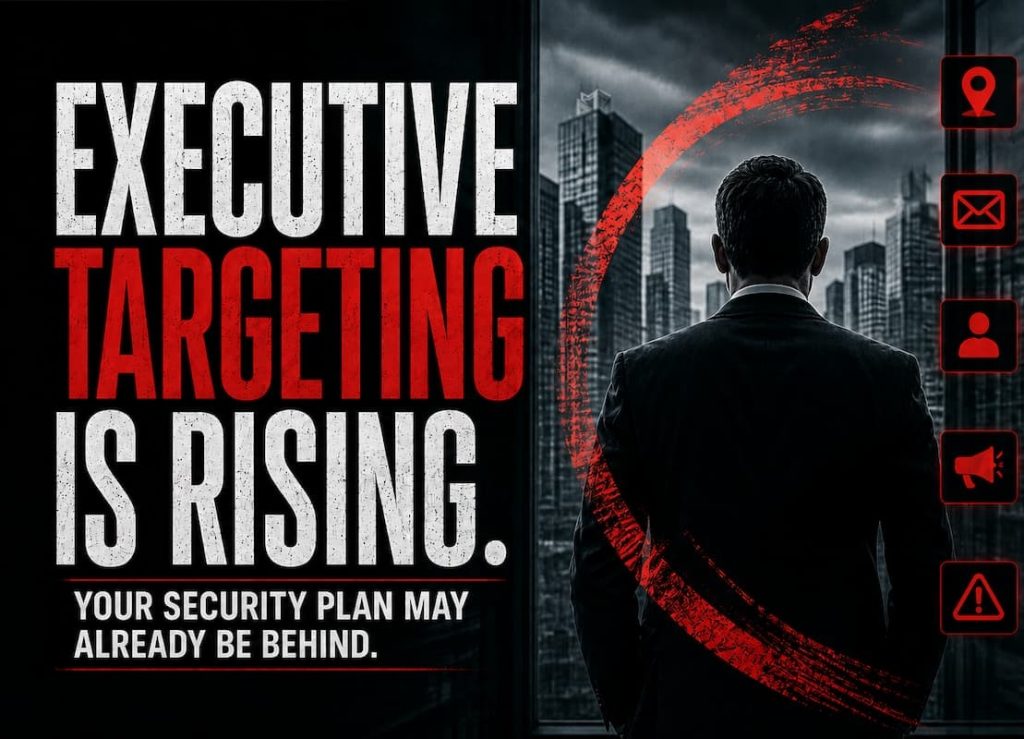
Executive targeting is rising, and many companies are still treating executive protection like a rare-event problem.
That gap is becoming dangerous.
Threats against executives are moving beyond angry emails, online comments, and uncomfortable public encounters. Today, the risks include doxxing, stalking, harassment, workplace violence, residential exposure, threats to family members, and attacks tied to a leader’s company, industry, decisions, wealth, or public visibility.
For C-suite leaders, the message is uncomfortable: visibility frequently creates exposure.
For organizations that work in security and risk, the shift is hard to miss. It is showing up in boardroom questions, executive risk assessments , family office conversations, and organizations that never expected executive protection to become part of their planning.
- Who knows where our executives live?
- What happens if online anger becomes a physical threat?
- What to do before law enforcement arrives If they decide to get involved?
Today, a threat can gather momentum long before anyone realizes it’s becoming one.
 What Is Executive Targeting?
Executive targeting refers to threats, intimidation, harassment, physical attacks, doxxing, stalking, or violence directed at senior leaders because of who they are, what they represent, or the organization they lead.
The target may be a CEO. It may also be a board member, founder, senior executive, general counsel, public-facing nonprofit leader, or family member.
The motive may be personal. It may be political, ideological, financial, reputational, or grievance-driven.
That is what makes the threat difficult. The leader may never have met the person targeting them. The company may simply represent something the attacker resents.
Healthcare. Technology. Finance. Insurance. Energy. AI. Defense. Education. Media.
The industry itself can become the grievance.
Threats Against Executives: The Data Is Catching Up to the Headlines
Recent reporting and security industry research point in the same direction regarding threats against executives
Allied Universal’s World Security Report found that 46% of U.S.-based chief security officers reported an increase in threats of violence toward executives over the past two years. Among technology companies, that number rose to 66%.
The Security Executive Council analyzed 424 open-source incidents targeting senior private-sector executives between 2003 and late 2025. Physical attacks made up 85% of incidents, one-third resulted in injury or death, and 2025 had already doubled 2024 totals by October.
ASIS Security Management reported that CEOs remain the primary targets, while attacks on other senior executives are also rising, especially in technology and finance.
Corporate spending is starting to reflect the concern. The Conference Board reported that 2024 saw record spending on personal and home security for CEOs at S&P 500 companies, along with a 29% year-over-year increase for CEOs at Russell 3000 companies.
Reuters also reported that companies increased security spending after the killing of UnitedHealthcare executive Brian Thompson, with more attention being paid to protection for senior leaders, homes, travel, and public events.
The data doesn’t lie, and the pattern is not subtle – Executive targeting is a growing risk to the C-suite.
 C-Suite security: Why Companies Ignore Executive Targeting Until It Is Too Late
Many organizations understand the executive targeting risk in theory. Fewer are ready to act on it. And often, it is the executive themselves questioning it.
Usually, the pushback falls into three categories.
1. “We’re Not That Kind of Company”
Some leaders still believe executive protection is for billionaires, celebrities, controversial founders, or public officials. That assumption is outdated.
A company does not need to be famous to become symbolic. A CEO does not need to be a household name to become a target.
A leader may represent layoffs, denied claims, automation, rising prices, unpopular policies, political assumptions, industry anger, or economic frustration. That is enough.
In a volatile climate, visibility can become vulnerability.
2. “We Already Have Security”
This is where many companies confuse visible security with real protection.
Cameras are useful. Badges are useful. Access control is useful. They are still only pieces of a larger system.
A camera can show you what happened. It does not assess intent or directly intervene during an attack. A badge system can control authorized access. It does not monitor grievance. A lobby desk can slow someone down. It does not replace threat intelligence, planning, training, and rapid response.
This is the “show-me security” problem.
It looks reassuring. It may satisfy a checklist. It may even deter low-level incidents.
Determined people often move faster than static systems.
3. “It Feels Excessive”
Some executives push back because protection feels dramatic. They worry it will look elitist, change the culture, disrupt privacy and their family, or signal fear.
That reaction is understandable. It is also risky.
Executive protection does not always mean a visible security detail. Often, the smarter approach is quieter: an executive threat assessment, a home security review, safer travel routines, event planning, online exposure reduction, and clear escalation protocols.
The person targeting your executive may be researching, rehearsing, and waiting. Your defense needs the same discipline.
 Why C-Suite Security Plans Are Falling Behind
The strongest protection programs are built around anticipation.
That means understanding the person, the role, the company, the public climate, and the pathways a threat could take.
A serious executive threat assessment should ask:
- Who has a grievance?
- Who has made contact?
- What information is publicly available?
- Where are the predictable routines?
- How exposed are family members?
- What happens at the home, office, hotel, airport, restaurant, conference, or public event?
- Who gets the first call?
- Who decides when concern requires action?
Many organizations have pieces of this. Few have it fully connected.
Pearl Meyer’s survey of 258 organizations found that 65% lacked a formal CEO security program. Only 9% had adopted comprehensive, multi-layered security programs, and 73% relied on informal judgment.
That gap shows that the risk of threats against executives is rising faster than many companies are adapting.
Executive Protection Now Includes the Home, the commute, and the Routine
For C-suite security, the office is only one part of the threat surface.
Executives live in patterns. They commute. They attend conferences. They take meetings in public places. They travel with predictable habits. They post online. Their spouses, children, assistants, drivers, and household staff may also become part of the security picture.
- A founder at a controversial technology company may need one approach.
- A healthcare executive may need another.
- A nonprofit leader working in a polarizing issue area may need another.
- A board chair managing a public crisis may need another.
Effective executive protection is calibrated. It should match the leader’s exposure, role, industry, public profile, travel, home environment, digital footprint, and organizational responsibilities.
 What Smart Organizations Are Doing Differently
The best organizations are moving from reactive security to risk-based protection. They are asking better questions earlier.
They are conducting executive risk assessments and residential security assessments before something happens. They are reviewing home and travel exposure. They are monitoring public-facing threats and online hostility. They are training executive assistants and front-desk teams to recognize escalation. They are connecting corporate security, legal, HR, communications, cyber, and the executive office.
They are also being honest about what their current security can and cannot do.
If the plan depends on law enforcement arriving after a threat has already reached the executive, it needs work.
The same is true if home protection begins and ends with a camera system, if the leadership team has never practiced a threat scenario, or if the board has never discussed executive security.
Executive Protection Belongs on the Risk Agenda
A credible threat can disrupt operations. An attack can damage morale, investor confidence, public trust, and brand reputation. A residential incident can create privacy, legal, family, and reputational consequences. A failure to prepare can raise uncomfortable questions about duty of care.
Boards and leadership teams do not need to become security experts. They do need to know who owns the plan.
They should know how threats are assessed, how leaders are protected, how family exposure is handled, how events are evaluated, how travel is reviewed, and how decisions are made when something feels wrong.
CEO security is no longer just a personal benefit. It belongs in the same conversation as workplace violence prevention, crisis management, business continuity, cyber risk, and reputational risk.
Threats Against Executives: Preparation Is Not Paranoia
Executive targeting is rising. The headlines are saying it. The surveys are showing it. Security professionals are seeing it in real time.
For many companies, the challenge is cultural. They do not want to overreact. They do not want to alarm leadership. They do not want to spend money on a problem that still feels unlikely.
But risk does not wait for comfort. Executive protection replaces fear with readiness.
It is about knowing where leaders are exposed, who may be watching, what systems are actually protective, and what happens when grievance moves from words to action.
We protect executives most people have never heard of. They prefer it that way. Follow us here for insights, strategy, and real-world analysis. And when you’re ready to talk security, you can always Talk To Us.
Here’s how reaching out to TAL Global works:
- We assess your exposure.
We look at your leadership profile, public visibility, digital footprint, routines, travel, events, and current security posture. - We identify the gaps.
We separate real protection from “show-me” security and determine where your people, places, and processes are vulnerable. - We build a practical protection strategy.
You get recommendations that match your risk, culture, budget, and leadership reality.
About TAL Global
TAL Global is an international security consulting and risk management firm with over 28 years of proven experience. We protect people, places, assets, and logistics in an increasingly complex and connected world.
Operating across the full landscape of security risk, our work includes workplace violence prevention, executive protection, investigations, travel security, emergency preparedness, and more.
Our team includes former federal agents, military veterans, executive level leaders, and crisis response experts recognized for delivering results under pressure. We are trusted by Fortune 500 companies, government agencies, and mission driven organizations worldwide.
Follow us on LinkedIn and YouTube for expert tips and strategies. Or reach out directly to Talk To Us about custom and actionable risk management strategies for your organization.