Understanding the difference between a protest and a riot is essential for leaders, security professionals, and risk managers looking to make informed decisions in the moment.
And in today’s climate, this isn’t just a legal question. It’s an operational one. It’s more than semantics, it shapes how leaders prepare, respond, and communicate during periods of unrest.
 What’s the Difference Between a Protest and a Riot, and When Does it Become a Terrorism Threat?
You’re watching live footage. People are chanting. Police are standing by. There’s a march outside your office, or your kid’s school, and someone asks, “Are we in danger?”
And you don’t know. That’s the moment this question becomes real. Not for the courts, but for you as a decision-maker.
That’s when people start Googling how to prepare for protests at work, but the truth is that you should be preparing now, before risk knocks on your door. Emergency preparedness comes from training your team, understanding your thresholds, and having conviction in your readiness.
What Is a Protest? Understanding Protected Speech and Disruption
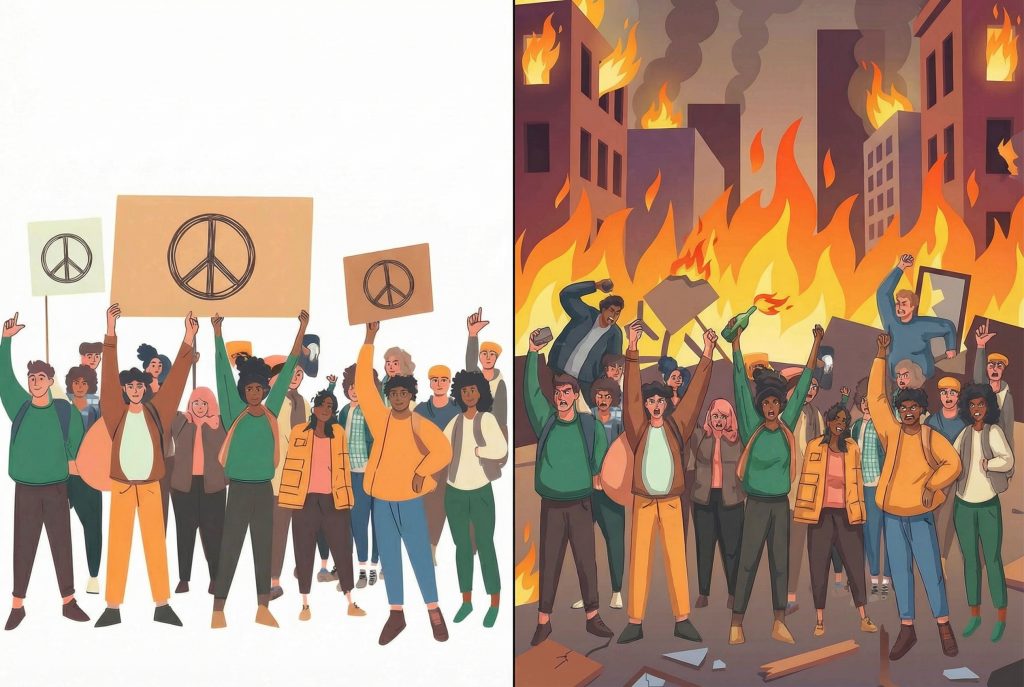
- A protest is protected speech. People are there to express something. Loud, sometimes angry, but focused on a message. Disruption might be part of it, but violence isn’t.
From a security standpoint, every public gathering should be evaluated through a protest risk assessment: looking at context, crowd intent, and environmental factors.
“Protests are meant to be disruptive. That’s the point. But when people start throwing punches or breaking windows, it crosses a line. That’s no longer protest. That’s a public security and safety risk.”
Difference Between a Protest and a Riot? Signs of Escalation
- A riot is when that order breaks. It’s no longer about the message. It’s about action. Usually impulsive. Often destructive. Contagious by nature. Most riots aren’t planned, they escalate.
Without a defined escalation response plan, teams are left guessing when tension rises. That’s when mistakes happen, either through overreaction or silence.
“Sometimes it’s people within the protest that escalate. Sometimes it’s outside agitators. Either way, it stops being about protest and starts being about disruption. Most riots are spontaneous, they spark, spread, and spiral.”
 What Counts as Terrorism? How to Recognize Ideological Violence
- A terrorism threat is something else. It’s not reactive, it’s deliberate. Violence used to send a broader message. It’s planned. It targets symbols. It’s meant to create fear, not just make a point.
The difference between protest and a riot often comes down to intent and control. Protest maintains a message. Riots spiral away from one.
“Terrorism is calculated. It’s violence used to send a political or ideological message through fear. Doesn’t matter what side you’re on. If the goal is to scare people into silence, retreat, or obedience, it fits the definition.”
Here’s the catch: from a distance, all three can look the same.
That’s why leaders freeze. Because nobody wants to overreact. But nobody wants to underreact either. And in the middle of that hesitation is risk.
So what helps? Clarity. Not from the news. From inside your organization.
Clarity about:
- Who’s watching the horizon
- Who’s deciding the threshold for action
- What your people expect from you when the noise gets loud
Some protests stay calm. Some don’t. Some threats are noise. Some aren’t. You won’t always know in the moment, but you can be ready.
Preparedness is about removing the guesswork when the pressure’s on. So the real question isn’t, “is this a protest, a riot, or a terror threat?”
It’s, “are we prepared to respond to any of them?”
Smart leadership requires informed foresight and decisive readiness.
What to Do If You’re Facing a Protest, Riot, or Threat Situation
Follow us here for insights, strategy, and real-world threat assessment. And if you’re asking how to prepare for protests at work, we help you operationalize the policies, thresholds, and actions your team can rely on when tensions rise. when you’re ready to get clear on how your organization should respond, you can always Talk To Us.
Here’s what happens when you reach out:
- You call. We listen.
We’ll talk through what you’re seeing, whether it’s a protest on the horizon, a threat in your inbox, or the early signs of unrest that might require a protest risk assessment. - We clarify the threat.
Is it a protest? Is it likely to escalate? Is there a broader agenda? We help you separate signal from noise, map out intent, and understand how far it might go. - You get a tailored escalation response plan.
From comms guidance and lockdown triggers to liaison strategy and law enforcement coordination, you’ll walk away with a clear, pressure-tested plan that fits your risk, your people, and your environment.
Clarity when it counts.
About TAL Global
TAL Global is an international security consulting and risk management firm with over 28 years of proven experience. We protect people, places, assets, and logistics in an increasingly complex and connected world.
Our team includes former federal agents, military veterans, executive level leaders, and crisis response experts recognized for delivering results under pressure. We are trusted by Fortune 500 companies, government agencies, and mission driven organizations worldwide.
Follow us on LinkedIn and YouTube for expert tips and strategies. Or reach out directly to Talk To Us about custom and actionable risk management strategies for your organization.